

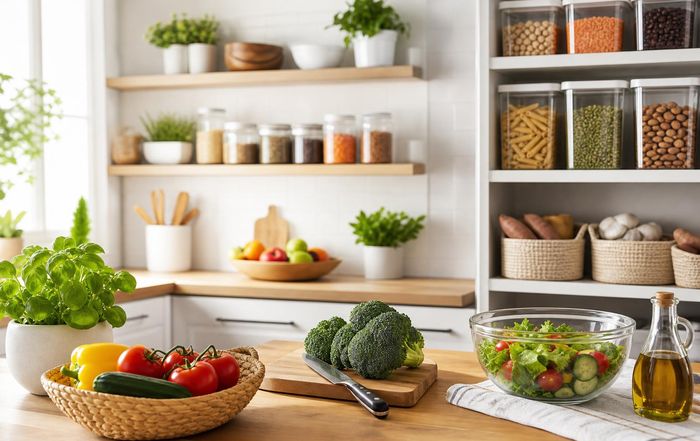
How to Organize a Kitchen for Easier Healthy Meals
A kitchen that fights you at every step-overstuffed cupboards, mystery leftovers, no counter space-makes healthy eating feel like a chore. A kitchen that's organized around how you actually cook does the opposite: it lowers friction, shortens prep time, and makes the healthy choice the easy, obvious choice.
This guide focuses less on "Pinterest-perfect" aesthetics and more on practical systems that support everyday healthy cooking, whether you live alone, share a small flat, or cook for a family.
Start With a "Healthy Cooking Audit"
Before buying containers or rearranging shelves, it helps to understand your real habits. Public health agencies such as the World Health Organization and U.S. Department of Agriculture emphasize that small, sustainable changes in routine are more effective than dramatic overhauls, and that applies in the kitchen too.
Spend a few days noticing:
What slows you down when you try to cook (missing tools, cluttered counters, no idea what's in the fridge).
Which healthy meals you actually enjoy and repeat.
Foods that regularly go to waste.
Times of day when you most need speed (early mornings, post-work dinners).
Then ask a few targeted questions: Do you want faster weekday breakfasts? Easier salad prep? More plant-based dinners? Clear priorities will guide how you set up your space and what you keep within easiest reach.
If you are also working on broader lifestyle changes, pairing this audit with a simple reflection practice-like a weekly check-in or journaling-can help, and resources on mindfulness and daily habits offer additional support.
Declutter With Healthy Eating in Mind
Decluttering is not about having fewer things for its own sake; it is about removing obstacles between you and a straightforward, nourishing meal.
Start with three categories: donate, recycle, and discard. Work in focused zones (one cupboard, one drawer) rather than the entire kitchen at once. As you go, think specifically about whether each item supports the kind of cooking you want to do now, not five years ago.
Consider letting go of:
Duplicate or rarely used gadgets that block access to everyday tools.
Old plastic containers without lids, stained or cracked items, and warped cutting boards.
Expired spices, baking ingredients, and dressings-these often accumulate unnoticed.
Ultra-processed snack foods you keep "just in case" but that routinely derail your plans.
Many nutrition experts, including those at Harvard T.H. Chan School of Public Health, highlight that environment strongly shapes food choices. If the most visible, easiest-to-grab items are chips and sweets, they are more likely to become default snacks. While there is no need for strict bans, reducing visual clutter from less-nutritious foods and making nutrient-dense options more accessible gently nudges daily decisions in your favor.
For more ideas on aligning your space with your wellness goals, you may find the broader tips in the wellness and lifestyle sections helpful.
Design Work Zones Around Healthy Meal Flow
Professional kitchens rely on clear work zones to move efficiently from raw ingredients to finished dishes. A home kitchen benefits from the same logic, even on a smaller scale. The goal is to reduce unnecessary steps so that making a stir-fry or salad feels almost automatic.
Think in terms of a simple flow: store → wash → prep → cook → serve. Then arrange your kitchen to support that sequence:
Near the fridge and pantry: Group everyday staples for healthy meals-whole grains, legumes, canned tomatoes, olive oil, vinegars, oats, nuts, and seeds. Keep them at eye level rather than hidden on high shelves.
Around the sink: Place colanders, salad spinners, cutting boards, and knives nearby so you can move easily from washing to chopping vegetables.
Beside the main prep area: Store mixing bowls, measuring cups, and frequently used utensils (spatulas, tongs, wooden spoons) in drawers or a countertop container.
Close to the stove: Keep pots, pans, heat-resistant utensils, and commonly used oils or spices within arm's reach, minimizing the temptation to skip cooking because it feels like a hassle.
The Academy of Nutrition and Dietetics notes that practical barriers-time, effort, and complexity-are among the biggest obstacles to healthy home cooking. A zone-based layout reduces those barriers, especially on busy evenings when willpower is low.
If you are also incorporating movement into your day, a well-organized kitchen can pair naturally with routines explored in fitness and health coverage, such as batch cooking after a workout or prepping lunches post-walk.
Make the Fridge a Healthy "Front-of-House"
The refrigerator is often where healthy intentions go to die: wilted herbs, forgotten leftovers, and mystery containers. A few structural changes can turn it into a visual menu of quick, nourishing options.
Start by emptying everything, wiping down shelves, and discarding expired items. Then, organize by visibility and food safety:
Eye-level: Place ready-to-eat healthy options-washed salad greens, cut vegetables, hummus, plain yogurt, leftovers ready to reheat. When you open the door, you should see ingredients that can become a meal in minutes.
Upper shelves: Store prepared foods and cooked grains or proteins in clear, labeled containers. Seeing a container of cooked lentils or roasted vegetables increases the odds you will use them.
Lower shelves: Keep raw ingredients that need more prep-whole vegetables, eggs, marinated proteins.
Drawers: Use crisper drawers for fruits and vegetables, adjusting humidity settings if your fridge allows. Group produce by type (leafy greens together, crunchy vegetables together, fruits together) so you can quickly assemble snacks and sides.
Food safety agencies like the U.S. Food and Drug Administration (FDA) and European Food Safety Authority (EFSA) emphasize correct storage temperatures and separation of raw and ready-to-eat foods. Store raw meat or fish on the lowest shelf in leak-proof containers to avoid cross-contamination, and keep your fridge at or below 4°C / 40°F.
To support healthy snacking and quick meals:
Pre-wash and chop some vegetables (carrots, peppers, cucumbers) and store them in containers of water or sealed boxes for 2-3 days of easy snacking.
Prepare a few "building block" items each week-such as cooked brown rice, quinoa, roasted chickpeas, or grilled chicken-to speed up weeknight cooking.
Keep a visible "eat first" box or section for foods that are close to their best-before date, reducing waste and encouraging creativity.
If you are curious about broader food trends and innovations, including smart fridges and food-waste technology, the innovation section often explores these developments.
Turn the Pantry Into a Healthy Meal Toolkit
A well-stocked, organized pantry is one of the strongest predictors that you will cook at home more often. Research compiled by the American Heart Association links regular home cooking with better diet quality and lower intake of added sugars and unhealthy fats, and a pantry of flexible staples makes that cooking far easier.
Instead of organizing purely by packaging, group items by how you use them in healthy meals:
Whole grains and pseudo-grains: Brown rice, quinoa, oats, barley, whole-wheat pasta.
Plant proteins: Lentils, chickpeas, black beans, other canned or dried beans, tofu shelf packs if you use them.
Healthy fats and flavor bases: Extra-virgin olive oil, canola or rapeseed oil, nuts, seeds, nut butters.
Quick flavor builders: Canned tomatoes, tomato paste, coconut milk, broths, vinegars, mustards, soy sauce or tamari.
Herbs and spices: Organize alphabetically or by cuisine, and keep the ones you use weekly front and center.
Transfer frequently used dry goods into clear containers if possible, labeling them with the product name and cooking instructions. This not only reduces visual clutter but also makes it easier to see when you are running low, which helps with shopping planning and reduces last-minute takeout orders.
Store less-nutritious treats or impulse buys on higher, less visible shelves. Behavioral research supported by organizations like The Behavioural Insights Team and public health departments suggests that simple changes to visibility and reach can meaningfully influence what people choose, without requiring strict rules.
Streamline Tools and Appliances for Everyday Use
Healthy cooking does not require a large collection of gadgets; it requires a small set of reliable tools you can reach quickly. A cluttered countertop, on the other hand, steals prep space and increases the mental load of starting a meal.
Focus on keeping these items accessible:
A good chef's knife, paring knife, and bread knife, kept sharp.
Two or three cutting boards (ideally separate for produce and raw meat).
A few versatile pots and pans: a medium saucepan, a large pot, and a wide skillet or sauté pan.
Baking sheet trays for roasting vegetables, fish, or chickpeas.
A blender or stick blender if you often make soups, smoothies, or sauces.
Store specialty appliances-waffle makers, ice cream machines, seasonal baking gear-out of the main work zone unless they play a regular role in your healthy cooking routine. This frees up space for items that directly support everyday meals, such as a rice cooker, slow cooker, or air fryer if you use them frequently.
If you are considering new equipment, it can help to cross-check claims with independent reviews from reputable outlets like Consumer Reports or major news organizations such as BBC and The New York Times, which often test kitchen tools in real-world conditions.
Create "Grab-and-Go" Stations for Snacks and Breakfast
Busy mornings and late-afternoon energy dips are common moments when people reach for convenience foods. Organizing specific zones for quick, nutritious options can dramatically change those defaults.
For breakfast, designate a small area of the counter or a cupboard as a "breakfast station," keeping together:
Oats, whole-grain cereals with minimal added sugar, and granola.
Nut butters, seeds, and unsweetened dried fruits.
Tea, coffee, and any supplements you use on professional advice.
Store bowls, spoons, and mugs nearby so you can assemble a balanced breakfast-such as oatmeal with nuts and fruit-in minutes. For those who like smoothies, keeping the blender, frozen fruit, and protein sources (yogurt, nut butter) easy to reach reduces friction even more.
For snacks, create a visible, easy-access snack basket or shelf with options such as:
Whole fruits (apples, bananas, citrus) that do not require refrigeration.
Small containers or jars of nuts and seeds.
Whole-grain crackers, rice cakes, or roasted chickpeas.
Place more indulgent snacks in opaque containers or higher cupboards. You are not banning them; you are simply making nutrient-dense options more convenient. This approach aligns with guidance from organizations like Public Health England and Health Canada, which emphasize practical, environment-based strategies for improving dietary patterns.
Readers interested in how food choices intersect with mood, stress, and productivity may find further context in the health and business sections, especially where workplace wellness and performance are discussed.
Label, Date, and Rotate to Avoid Waste
Food waste is both an environmental and a financial issue, and it can quietly undermine healthy eating by making your kitchen feel chaotic and discouraging you from buying fresh ingredients. The Food and Agriculture Organization of the United Nations (FAO) estimates that a significant proportion of food produced globally is lost or wasted, much of it at the household level.
Simple systems can make a big difference:
Label leftovers and prepped ingredients with the contents and date. A piece of tape and a marker are sufficient.
Adopt a "first in, first out" rule, placing newer items behind older ones in the fridge and pantry.
Dedicate one weekly meal-such as a weekend lunch-to a "use-it-up" dish, like a stir-fry, frittata, soup, or grain bowl that uses leftover vegetables and proteins.
Keep a small list or whiteboard on the fridge noting prepped items (e.g., "cooked quinoa," "roasted veggies") and their dates. This makes it easier to plan quick meals before ingredients lose quality.
Reducing waste aligns with broader sustainability goals and the interests of readers who follow environmental topics. For more on that intersection of food, climate, and daily life, the environment and world sections regularly highlight related issues.
Set Up a Simple Weekly Prep Routine
An organized kitchen is most powerful when paired with a light, repeatable routine. This does not require elaborate batch cooking; even 60-90 minutes once a week can dramatically lower the barrier to healthy meals on busy days.
Evidence from nutrition and behavior research, including work supported by the National Institutes of Health (NIH), suggests that planning and preparation are strongly associated with better dietary quality. In practice, a weekly rhythm might look like:
Check what you already have: Look through the fridge, freezer, and pantry, noting items that need to be used soon.
Sketch a loose meal plan: Choose a few flexible "anchor" meals-like a grain bowl night, a soup night, and a stir-fry night-rather than detailed recipes for every day.
Shop with a list: Base it on your existing inventory and chosen meals to avoid over-buying.
Prep building blocks: Cook one or two grains, roast a tray of mixed vegetables, wash and chop salad greens, and prepare a simple dressing or sauce. Store them in labeled containers at eye level in the fridge.
Keep the focus on repeatable habits rather than perfection. Over time, this rhythm becomes easier and more intuitive, especially when your kitchen layout supports quick washing, chopping, and storing.
Make Healthy Cooking Pleasant, Not Punishing
Finally, a kitchen that supports healthy meals is not only efficient; it is also a place you do not dread spending time in. Small touches that improve comfort and enjoyment can indirectly support better eating habits.
Consider:
Good lighting over the main prep area to reduce eye strain and make food more appealing.
A small speaker or radio for music, podcasts, or news while you cook-public broadcasters like NPR or BBC can make prep time feel like a break rather than a chore.
A clear section of counter that is always kept free of clutter, reserved solely for food preparation.
Integrating cooking into a broader self-care routine-perhaps after a walk, workout, or short meditation-can also shift how it feels. Readers interested in this more holistic approach to daily life may appreciate related coverage in wellness, travel for food culture inspiration, and even brands and news when new kitchen or food trends emerge.
A perfectly organized kitchen is not required for healthy eating. What matters is that your space makes the meals you want to eat easier than the ones you are trying to move away from. By decluttering with intention, designing simple work zones, making healthy foods more visible and ready to use, and adding a light weekly prep routine, you create a kitchen that quietly supports your wellbeing every day-without demanding constant effort or perfection.