

How to Plan a Sleep-Friendly Long-Haul Flight
Getting real sleep on a long-haul flight can feel like a luxury, but it is also a core part of arriving healthy, focused, and emotionally balanced-especially if you travel often for work, family, or wellness retreats. With a bit of planning before you leave home, you can turn a cramped overnight trip into a reasonably restorative experience rather than a test of endurance.
This guide brings together evidence-based sleep advice from leading health organizations with practical aviation know-how to help you design your own sleep-friendly flight routine.
Start with your body clock, not your ticket
Many people plan long-haul travel around price and convenience, but the timing of your flight can strongly influence how easily you sleep in the air and how quickly you adjust afterward. Human circadian rhythms are regulated by light exposure, meal timing, and social cues, so thinking about these elements before you book can make a difference.
When possible, overnight "red-eye" flights that depart in the evening and arrive in the morning at your destination tend to be more sleep-friendly than daytime ultra-long flights. They align more closely with your usual sleep window, which makes it easier to wind down once the cabin lights dim. For eastbound travel (for example, from North America to Europe), choosing a departure that allows at least 5-6 hours of potential sleep time after the first meal service can be helpful. Westbound flights often feel easier on the body clock, but if you arrive in the evening, you'll want to stay awake on board to preserve sleep pressure for night-time at your destination.
Research summarized by the U.S. Centers for Disease Control and Prevention (CDC) and National Sleep Foundation (sleepfoundation.org) suggests most adults need 7-9 hours of sleep per 24-hour period, even when crossing time zones. For very long segments (10-15 hours), aim for at least one solid 3-5-hour block of sleep and accept that it may not be as deep or continuous as at home. If you are prone to jet lag or have a history of sleep problems, consulting a clinician or sleep specialist before frequent long-haul travel can help you create a personalized strategy.
Choosing a seat with sleep in mind
Seat choice can make or break your in-flight rest, particularly in economy. While not everyone can upgrade to premium cabins, thoughtful seat selection within your budget can still significantly improve comfort and sleep quality.
Window seats are usually best for sleep because they provide a wall to lean against and are shielded from aisle traffic. You control the window shade and are less likely to be disturbed by seatmates getting up. Aisle seats offer more legroom flexibility but come with more bumps, light exposure, and interruptions. If you are tall or have circulation issues, an aisle may still be worth it for easier movement. Avoid seats near galleys and toilets where light and noise levels are higher and crew activity continues through the night. Online seat maps and user reviews on aviation sites such as SeatGuru (seatguru.com) or broader travel resources like Skytrax (skytrax.com) can help you identify quieter zones on specific aircraft types.
In economy, exit rows and bulkhead seats can offer extra legroom, but they sometimes have fixed armrests or tray tables in the arm, which slightly narrows the seat. Bassinet rows are helpful for families but can be less sleep-friendly for solo travelers because of baby noise. If you book basic economy or a similar restricted fare, check carefully whether seat selection is included; paying a modest fee for a better position can be a worthwhile wellness investment on a 10-hour overnight flight. Travelers with specific medical needs, mobility issues, or pregnancy should review airline policies and, if necessary, request seating accommodations in advance through the carrier's customer service or medical desk.
Build a minimalist but effective sleep kit
A small, well-chosen set of items can dramatically improve your chances of sleeping on board. You do not need a suitcase full of gadgets; instead, focus on blocking light, reducing noise, supporting your body, and maintaining comfort in a dry, cool cabin.
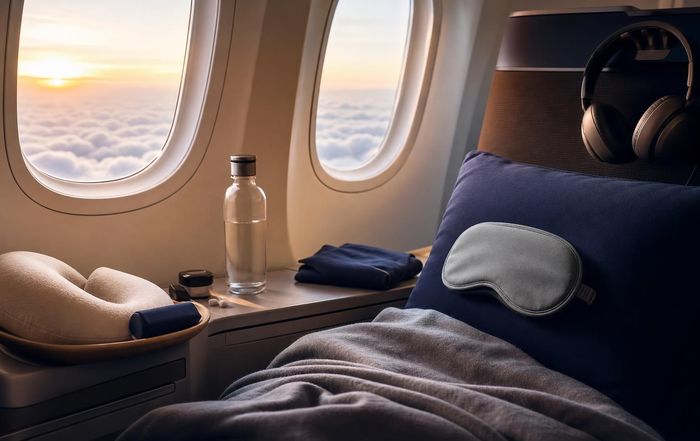
A good contoured eye mask helps block overhead lights, reading lamps, and screen glare, which is critical because light exposure directly influences melatonin production and circadian rhythm. Earplugs or noise-masking headphones can reduce engine hum, cabin announcements, and conversations. Foam earplugs are inexpensive and effective for many people, while active noise-cancelling headphones can be particularly helpful if you are sensitive to low-frequency engine noise. Organizations such as the American Academy of Sleep Medicine (aasm.org) emphasize the importance of a dark, quiet environment for sleep; in the air, these tools are how you approximate that.
Neck support is another key variable. Inflatable U-shaped pillows save space but can feel bouncy; memory foam or ergonomic designs that wrap around or support under the chin often provide better alignment. If you are in a window seat, a small, compressible pillow or folded sweater between your head and the wall can reduce pressure points. A lightweight travel blanket, large scarf, or merino shawl helps manage temperature swings, as cabins are often kept around 22°C (72°F) but can feel cooler due to low humidity and reduced movement.
For overall comfort, consider compression socks, which can help reduce leg swelling and may lower the risk of deep vein thrombosis (DVT) when combined with movement. Guidance from bodies such as the World Health Organization (who.int) and Mayo Clinic (mayoclinic.org) stresses the importance of mobility and, for higher-risk travelers, medical advice on DVT prevention. A small pouch with lip balm, nasal spray or saline mist, and moisturizer can also make the dry cabin air more tolerable and help you sleep without waking from discomfort.
For readers interested in broader comfort and self-care routines, related ideas around in-flight relaxation and body awareness connect naturally with topics explored in our wellness, massage, and mindfulness coverage.
Time your sleep and naps strategically
Simply "sleeping when tired" on a long-haul flight can backfire if it leaves you wide awake at 3 a.m. local time after arrival. A more intentional approach is to think in terms of your destination time zone and use the flight as a transition.
For eastbound overnight flights, many sleep specialists recommend shifting your schedule slightly in the days before departure: going to bed and waking 30-60 minutes earlier each day, if your lifestyle allows. The U.S. National Institutes of Health (nih.gov) and Sleep Foundation both note that incremental shifts can ease jet lag, especially for frequent flyers. Once on board, set your watch or phone to destination time and plan your main sleep block to overlap with local night-time as much as the schedule allows. That might mean skipping the second meal service or starting your wind-down early while others are still watching films.
For westbound flights, it is often better to stay awake for the first half of the journey to build strong sleep pressure for the local evening. Short naps of 20-30 minutes can be refreshing without causing sleep inertia or undermining night-time sleep. If you must nap for longer, aim for about 90 minutes, which is roughly one full sleep cycle for many people, and try to wake near the end of that cycle to avoid grogginess. This approach is not perfect-sleep cycles vary between individuals-but it is often more restorative than waking mid-cycle.
Once you land, exposure to natural daylight is one of the most powerful tools you have to reset your body clock. Health authorities such as the UK National Health Service (nhs.uk) emphasize morning light for advancing the clock (helpful when traveling east) and late-afternoon light for delaying it (helpful going west). Planning some gentle outdoor movement, such as walking near your hotel or exploring a park, can reinforce your new schedule and tie in with a broader lifestyle or travel routine.
Food, caffeine, and alcohol: what really helps sleep in the air?
Cabin service is part of the ritual of flying, but what and when you eat and drink can either aid or disrupt your sleep. Airline meals are often scheduled for operational reasons rather than circadian science, so it pays to think beyond the tray.
Heavy, greasy, or very salty meals can contribute to bloating and indigestion, which are more likely at altitude because of cabin pressure changes and relative dehydration. Many nutrition and health organizations, including Harvard T.H. Chan School of Public Health (hsph.harvard.edu), recommend lighter meals with lean protein, complex carbohydrates, and vegetables to support stable energy and digestion. If your flight departs late at night, consider eating a balanced meal on the ground at your usual dinner time and declining or minimizing the in-flight service so you can maximize your sleep window.
Caffeine deserves special attention. Its half-life is typically around 5-6 hours, meaning that a strong coffee consumed in the middle of the flight can still be affecting your nervous system near landing. General guidance from the U.S. Food and Drug Administration (fda.gov) suggests most healthy adults can tolerate up to 400 mg of caffeine daily, but sensitivity varies widely. On overnight flights, many travelers find it helpful to avoid caffeinated coffee, tea, and energy drinks for at least 6-8 hours before their planned sleep time and to switch to water or herbal infusions instead.
Alcohol is often perceived as a sleep aid because it can initially make people feel drowsy. However, evidence from organizations such as Alcohol Change UK (alcoholchange.org.uk) and sleep research bodies shows that alcohol fragments sleep, reduces REM sleep, and can increase nighttime awakenings. At altitude, alcohol's dehydrating effect is amplified, and its impact on coordination and judgment can be more pronounced. If you choose to drink, it is wise to keep intake modest, alternate with plenty of water, and avoid alcohol in the hours immediately before your planned sleep block. For those focusing on overall health, our health section explores wider effects of alcohol and lifestyle choices on long-term wellbeing.
Hydration, movement, and circulation
The air in most modern aircraft cabins is significantly drier than typical indoor environments, often with relative humidity around 10-20%. This dryness, combined with long periods of sitting, can leave you feeling fatigued and increase the risk of headaches, dry eyes, and muscle stiffness-all of which can interfere with sleep.
Drinking water regularly throughout the flight is more effective than consuming a large volume at once. There is no universal "right" amount, but many aviation medicine experts suggest aiming for a steady intake and using thirst and urine color (pale straw is usually a good sign) as practical guides. Limiting diuretics such as alcohol and high-caffeine beverages can help maintain hydration. Some travelers also find electrolyte tablets or low-sugar sports drinks useful, though for most healthy adults, water is sufficient.
Movement is essential for both comfort and safety. Sitting still for long periods can contribute to leg swelling and, in some cases, increase the risk of blood clots. Organizations like the International Air Transport Association (iata.org) and various national health agencies recommend simple in-seat exercises-ankle circles, calf raises, gentle stretching-as well as periodic walks up and down the aisle when the seat-belt sign is off. Compression stockings may be especially beneficial for people with additional risk factors such as recent surgery, pregnancy, or a history of clotting disorders, but these individuals should seek medical advice before travel.
Integrating mindful movement and body awareness into your flight can also support a holistic sense of wellbeing. Gentle stretches, breathing exercises, or short guided practices (downloaded before you fly) can serve as bridges between wakefulness and sleep and align with broader fitness and wellness goals.
Mindset, stress, and in-flight relaxation techniques
Even with perfect planning, anxiety, excitement, or work pressure can keep your nervous system in "high alert" mode, making it difficult to fall asleep. Managing your mindset is therefore as important as managing your seat and schedule.
Creating a simple wind-down routine that you repeat on every long-haul flight can signal to your brain that it is time to rest. This might include dimming your personal screen, putting on your eye mask and earplugs, doing a short breathing exercise, and listening to a familiar audio track or guided meditation. Apps and tools from mental health organizations and meditation platforms, many of which draw on approaches endorsed by bodies like Mental Health America (mhanational.org) or national psychological associations, can be downloaded in advance for offline use. The key is consistency: using the same sequence each time helps build an association between the routine and sleepiness.
Simple breathing techniques such as slow diaphragmatic breathing or the "4-6" pattern (inhale for four counts, exhale for six) can activate the parasympathetic nervous system and reduce heart rate. Some people find progressive muscle relaxation helpful: working through the body from feet to head, tensing each muscle group for a few seconds and then releasing. These methods are low-risk and can be practiced discreetly in an airplane seat. For readers exploring broader stress-management and mental wellbeing practices, our mindfulness and wellness sections offer additional context.
If you are a nervous flyer or experience panic symptoms, consider speaking with a mental health professional before travel. Cognitive-behavioural strategies, exposure-based approaches, or, in some cases, short-term medication plans may be appropriate. Airlines and aviation authorities often provide educational resources on fear of flying, and some carriers run dedicated courses to build confidence and understanding.
Medications, melatonin, and when to seek medical advice
Many travelers consider using sleep medications or supplements to cope with overnight flights and jet lag. While these can have a place for some people, they are not a universal solution and carry important caveats.
Over-the-counter antihistamine-based sleep aids can cause next-day drowsiness, impaired coordination, and dry mouth, which may be particularly problematic in the already dehydrating cabin environment. Prescription hypnotics and certain anti-anxiety medications can significantly impair reaction time and judgment, raising safety concerns in an emergency and sometimes increasing the risk of sleep-related behaviors such as sleepwalking. Authorities such as the European Medicines Agency (ema.europa.eu) and national regulators generally advise cautious, short-term use under medical supervision.
Melatonin, a hormone that helps regulate circadian rhythms, is widely used as a supplement in some countries. Evidence suggests that low-dose melatonin taken at carefully timed intervals can help shift the body clock and reduce jet lag for certain routes, especially eastbound travel across multiple time zones. However, optimal dosing and timing vary, and product quality can differ between brands. Consulting a healthcare professional who is familiar with your medical history is advisable before using melatonin, particularly if you are pregnant, breastfeeding, taking other medications, or managing chronic conditions.
In general, combining modest, medically supervised use of such aids (if appropriate) with non-pharmacological strategies-light exposure, sleep scheduling, relaxation techniques, and healthy habits-tends to be more sustainable than relying on pills alone. If you have obstructive sleep apnea, cardiovascular disease, respiratory problems, or other significant health conditions, a pre-travel consultation with your doctor is especially important. They can advise on oxygen needs, mobility considerations, and whether any additional documentation or airline coordination is required, which can intersect with broader health and world travel issues.
Clothing, hygiene, and small comforts that matter more than you think
What you wear and how you manage basic hygiene on the plane can influence not only comfort but also your psychological readiness to sleep. Tight waistbands, rigid fabrics, and complicated layers can make it harder to relax into drowsiness or change positions during the night.
Soft, breathable layers-such as cotton, bamboo, or merino wool-allow you to adjust to cabin temperature changes. Slip-on shoes or sandals make it easier to move around without wrestling with laces in the aisle. If you remove your shoes, wearing clean socks (ideally compression socks) protects your feet and keeps you more comfortable when using the restroom. Some travelers pack a dedicated "flight outfit" that they associate with rest and recovery, similar to loungewear or pyjamas at home, which can support a mental shift toward sleep.
Simple hygiene steps-brushing your teeth after the last meal service, washing your face with a gentle wipe or water, and applying moisturizer-can help you feel more like you are following a normal bedtime routine. This sense of normality can be soothing for the nervous system and aligns with sleep-hygiene recommendations from bodies like the American Psychological Association (apa.org). A small kit with a toothbrush, toothpaste, face wipes, and a change of underwear can make a surprising difference in how restored you feel both during and after the flight.
For those interested in beauty and skin health while traveling, our beauty and environment sections also explore how climate, pollution, and lifestyle factors affect the skin and what that means for sustainable self-care choices on the move.
Integrating flight sleep into a broader wellness routine
A single long-haul journey rarely defines overall health, but for frequent travelers-whether for business, family commitments, or global adventures-the cumulative impact of disrupted sleep, changing time zones, and irregular routines can be significant. Chronic sleep restriction is linked to mood changes, impaired cognitive performance, and increased risk of metabolic and cardiovascular problems, as highlighted by organizations such as the World Health Organization and National Institutes of Health.
Treating flight sleep as one component of a broader wellness pattern can help. That might mean planning lighter work or social schedules immediately after very long flights, scheduling key meetings a day later when possible, or building in recovery time with movement, nutritious food, and natural light exposure. If your work regularly demands international travel, discussing sustainable schedules, remote options, or rotation patterns with your employer may be part of a longer-term business and jobs conversation.
Ultimately, a sleep-friendly long-haul flight is less about chasing a perfect eight hours in a narrow seat and more about stacking many small, realistic advantages in your favor: a thoughtfully chosen route and seat, a compact sleep kit, wise food and drink choices, gentle movement, and a calming pre-sleep ritual. Together, these steps can turn long-distance travel into a more manageable, and even restorative, part of a balanced, global lifestyle.